When Platinum Rusts V2 (work in Progress)
Chapter from "coming soon" book (Raw)

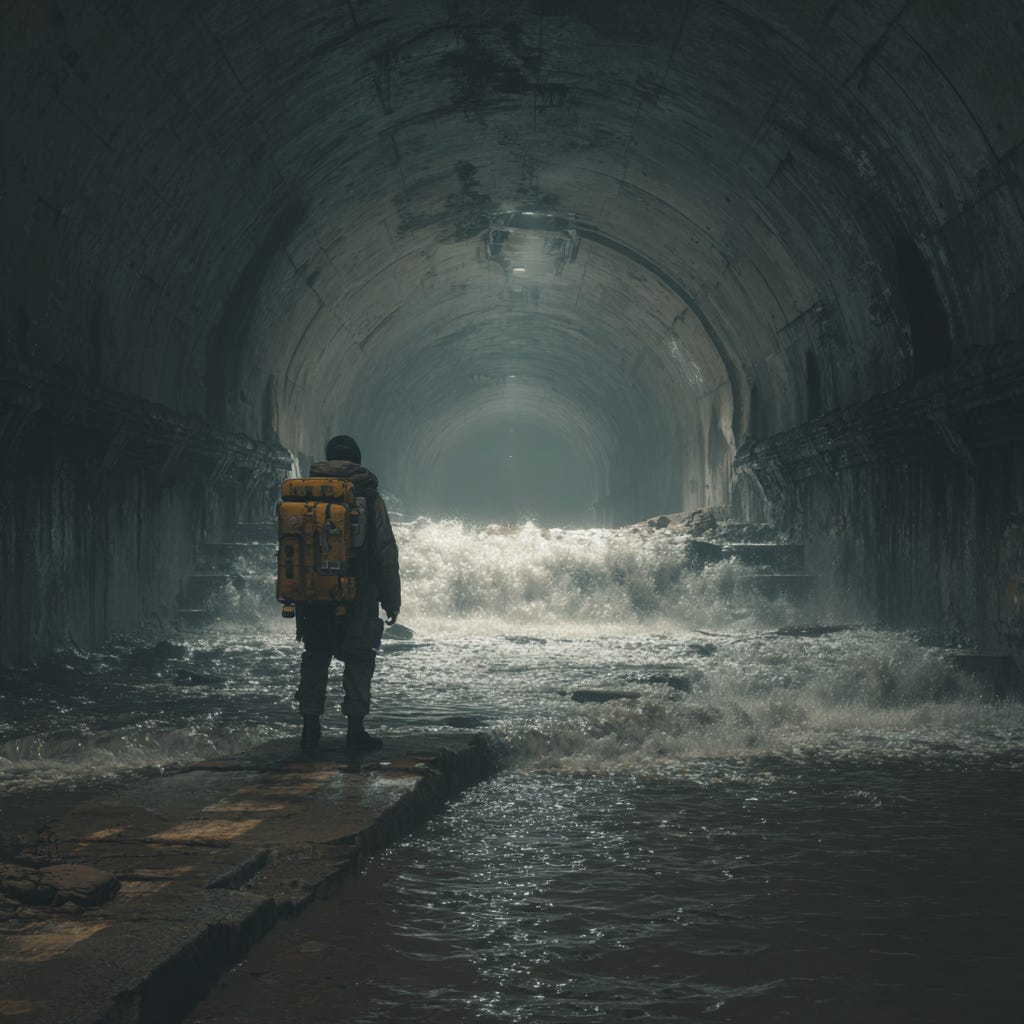
Maiser clawed his way onto the slab, coughing brine and bile, his chest burning. The tunnel roared around him with the laughter of water, echoes bouncing off cracked walls like a crowd that had paid to watch him drown. He sprawled there, trembling, clutching the monstrous backpack like his only link to what should be. He grabbed his bruised nose, relieved to find that it was badly grazed but not broken.
But Karagoz was gone.
Her absence was more frightening than the darkness. It was hard to believe—Karagoz, who could out-stare a Matron and hoist a mule’s load without breaking a sweat. The girl who seemed to have a plan stitched behind her eyelids, who carried more in her head than Maiser had learned in his life—and everything his ancestors might have remembered for five generations back. And now… just water and this cave.
Despair did not last long. Maiser reminded himself that Loaders were not merely encyclopaedias with legs—they were built tougher than they looked, in ways he had not yet grasped. She had to be alive. Captured. And he had to find and free her. He could not fulfil Karagoz’s mission without her, nor could he return to the Oak.
He forced himself onto his knees, spitting and shivering, blowing his nose furiously. It felt as if the stench of salt and rust were corroding his nasopharynx. He strained his ears, hoping for a splash, a cry.
Nothing. If there were any sounds he wanted to hear, they were drowned out by the roar of the underground stream.
Maiser stood. There was no way he could go far with all their luggage, and her pack had to be more valuable than his. But it weighed more than he could manage in his condition. He thumbed his ZPE lantern on and took stock. The slab was no natural stone: beneath his boots lay the tiled remains of flooring, the drowned skin of some forgotten facility.
The black water slid past, hungry, whispering promises. If he jumped back in, he would never climb out. If he stayed, the Matrons’ hunters would find him. And somewhere, either above or below, Karagoz was alive—or not. The thought cut like glass.
He pressed his forehead to the cold, wet pack and muttered, “Well, Vatslav lad, you swore to Gleb to protect her or die trying. You’d better keep your word.”
No one heard him but the cave. And it did not comment.
Then the world bucked.
Not a roar—not at first. A shiver, as if the stone had drawn a breath it could not hold. The water around Maiser’s boots rippled, then leapt. The walls made a sound like teeth chattering in a giant skull.
He froze.
Another pulse struck, sharper this time. The ceiling shed grit and thin, slicing flakes of rust. Maiser’s torch beam jittered across the tunnel as if someone were shaking the universe by the shoulders. The word buried formed in his mind, heavy as a verdict.
He dropped to his knees, the pack dragging him sideways, arms thrown over his head as if they could bargain with stone. The quake deepened—no longer trembling but thudding, a sequence of impacts rather than a single convulsion. Above him, somewhere beyond the rock, something massive gave way. He heard it as a hollow boom, then a tearing crash, as if one of the buildings above were folding in on itself, layer by dying layer.
“Not like this,” he whispered into water, into dark. “Not here.”
But the cave did not close.
Instead, it cracked.
A seam split along the upper wall, a hairline that widened with a sound like fabric ripping under too much strain. From it poured dust—and then, impossibly, air. Not the dead breath of salt and rot, but smoke, hot and acrid, threaded with the ghost of burning plastic.
Maiser was afraid to move, as though doing so might reverse the process.
The world froze as abruptly as it had shuddered. Even the stream seemed to subside, as if wondering whether it might change course this time.
With an old man’s groan, Maiser hoisted Karagoz’s sack onto his back and followed his poor nose, still throbbing both inside and out.
Stone scraped his shoulders. The pack caught, tore loose a rock, and then Maiser was clawing upward, coughing, hauling himself through the wound the quake had carved. He burst out into the cloud of settling dust and soot, dragging the sack behind him.
He scanned the ruin. It looked like just another dead city: crumbled, burnt, and looted. Only this one shrugged from time to time.
When the dust settled, he took it in properly. A street, almost disappeared under the remains of fallen skyscrapers. The smouldering wreck of a camp tent, fire gnawing its plastic ribs. The acrid smoke had filtered even underground. Near the embers lay a charred animal, its limbs curled black. No living soul remained. But someone had stood there moments before—someone had owned that fire, that space. Now only an enormous concrete slab lay where a body might have been, turning someone into part of the ruin.
Maiser stood shaking in the aftermath, smoke stinging his eyes, while the Earth beneath his feet pretended to be innocent, as if nothing extraordinary had happened.
Below him: a cave that should have been his tomb.
Around him: a city that had killed to set him free.
“So,” he murmured hoarsely, “are you trying to fossilise your trespassers or… break yourself.”
The street did not answer. The quake had said everything it intended to say.
Navigation was never simple, but he trusted his engineer’s brain more than his luck. If nothing else, Maiser knew how to take things apart, mark the pieces, and put them back in some semblance of order.
The sun gave him bearings—feeble, filtered through the dust, but better than nothing. He needed to hide Karagoz’s sack from passing Thieves.
He chose a ruin beneath a half-fallen orange sign. The paint was almost gone, but it made the building stand out like a sore tooth. Inside: no furniture, no scraps, just bare stone. Maiser hauled the sack to a leaning slab of wall, pressed his zapper glove to it, and fired. The charge cracked like thunder. The slab collapsed neatly, sealing the pack in rubble.
“There,” he muttered. “Safe as treasure in a beggar’s grave. Thanks for the hint.” He winked at… something. He was not sure what.
From his own pack, he stripped down to the essentials: food, flask, a spare shirt, and his weapon. The black stone on a silver chain—Selest’s last gift—was his only bargaining chip left. He taped his zapper to the back of his hand with a rag, as if it were a wound. Everything else he buried. The Matrons, he now knew, would take it anyway.
After an hour of soaking in the thin sunlight like a lizard, Maiser set off again—towards the shadow of the torn bridge on the horizon.
For two days he walked. Two days of dust and hollow silence, of hunger and rationed rests. He marked streets with a piece of brick, sketched ruins in his mental notebook, as if the act of naming could make him master of this wilderness. But in truth, the city was already gnawing at him.
By the time he found the underground entrance again, he was practically empty-handed. His food was gone, his water a memory. He offered the pendant on the chain to the gatekeepers—an iron-jawed man and a woman with wild eyes—and nearly had his throat slit for the effort. Only his plea—that he sought his “mistress”, to whom he was devoted—stayed their hands.
They dragged him down through the station halls, and Maiser bit his tongue bloody to hold back questions. Only one of the guards let slip what he dared not ask: his mistress had killed the moray eel—and another woman, to claim her man.
Maiser did not push further.
Instead of being marched back into the sewers, he was led into something stranger: unexpectedly clean rooms, lit with pale lamps, tiled walls gleaming. Once, these had been beauty salons, boutiques, places of vanity. Now they belonged to the Matrons.
And there, in one of the rooms, Maiser stopped dead.
Karagoz sat alive and well in the light, writing something on a piece of plywood. With her were Hajoon and his boy, Chang, heads lowered like servants. The air around them hummed with the unspoken fact: they now belonged to her.
As Maiser realised with a chill, so did he.
Karagoz did not look up at once.
She finished the line she was carving into the plywood with a stub of charcoal, blew gently to clear the dust, and only then raised her head. Her eyes flicked, not to him, but past him—towards Hajoon and Chang.
“Go,” she said. Not unkindly. Not loudly. “Fishing nets will need mending. The western sump runs warmer this hour.”
Hajoon understood the meaning but hesitated. He glanced at Maiser, then at her, weighing obedience against curiosity. Chang lingered longer, bare feet scuffing the tiled floor, eyes bright with questions he had learned not to ask.
Karagoz softened, just a fraction. “Bring me something with silver skin,” she added. “He likes silver.”
Chang smiled at that—quick, secret—and let himself be led away.
When the door slid shut, the room changed.
The hum of the lamps seemed suddenly too loud. The air was rich with soap and damp stone and something well matured—control, perhaps. Karagoz leaned back against the wall and exhaled through her nose, as if she had been holding her breath since the moment he had climbed out of the tunnel.
“You look like death reheated,” she said.
Maiser laughed once, a cracked sound. “Nice to see you too.”
She crossed the room and gripped his shoulders. Not a friendly touch. A check. Alive. Solid. Hers.
Her thumbs pressed briefly into the hollows beneath his collarbones, where the cold still lived. A sharp but fleeting pain in his forehead told him that he did not need to explain his little adventure. She already knew everything—even the way back to her luggage.
“Gleb was right about you. You are more than you let people see. I am surprised you made it back alive. They hurt you?” she asked.
“No,” he said. “They fed me. Which was worse.”
That earned a ghost of a smile. Karagoz stepped back, black eyes sharp now, calculating again. Always that sense with her—as if several versions of the moment were stacked behind her gaze, and she was choosing the safest one to inhabit.
“You weren’t meant to swim so fast,” she said.
“I wasn’t meant to lose you in a flooded hole either.”
Her jaw tightened. “I didn’t lose myself.”
“No,” he agreed quietly. “You claimed territory.”
That made her look at him properly.
Good, he thought. At least we are still speaking the same language. It felt like not two days had passed, but weeks instead.
She gestured for him to sit, then remained standing herself, arms folded. The posture was deliberate. Here, it mattered who took space and who occupied it—and who kept it.
“They believe I’m favoured,” Karagoz said. “Touched by the Pattern. They don’t have a word for what I am, so they pretend I’m something they already understand.”
“Which is?”
“A proof,” she said. “That their way works. Some even tried to test it, as they would and should.”
Maiser rubbed his face with both hands. The room swam slightly. “And does it work?”
“No,” she said flatly. “But it’s stable. For now.”
He really looked at her then. She was not as civilised and tidy as she had been on Oak, yet she was groomed in a peculiar way: her hair was neatly gathered and smoothed with some fragrant oil, now more bronze than copper. Her skin was clear but covered with unfamiliar symbols and inscriptions. The Matrons had polished her as one polishes a weapon before displaying it on a wall. Leather straps crossed a soft tunic, and her wide belt could have held an entire arsenal, though he had not yet seen what it carried. What he saw at once was Selest’s gold medal on her chest. He hoped she had reclaimed it from the leader so she could one day return it to Doctor Dvali.
“And the killing?” he asked. “The eel. The woman?”
Karagoz’s eyes flicked to the door. Then back to him.
“I challenged her and claimed her status,” she said. “Not me. The rules.”
“I don’t like this. We still have a mission, don’t we?”
“Our mission starts here,” she replied. “You will understand. But in this place, rules are everything. Break them loudly and you die. Break them correctly and you inherit.”
Maiser absorbed that in silence.
“And me?” he asked at last. “What am I here?”
She hesitated. Just a breath. But he saw it.
“You are a male that belong to me,” she said. “On record. In public.”
His mouth twisted. “Great.”
“It keeps you alive,” she said sharply. “It keeps Chang and Hajoon safe. It gives me room to think.”
“And how long do we stay thinking?”
“As long as it takes,” she said. Then, softer: “As long as it’s safer inside than out.”
Maiser leaned back against the cool tile, finally letting the day settle into his bones.
“The world’s still ending,” he said.
“I know.”
“They don’t.”
“I know.”
“And when they find out?”
Karagoz looked at the ceiling, at the neat lines of the lamps, the careful geometry of borrowed civilisation.
“They won’t,” she said. “They would have died out anyway. A system like theirs doesn’t build. It corrodes. They will be gone long before even that. This place will digest them faster unless… someone pulls them out.”
Maiser stared at her. “You?”
Karagoz laughed. “No. Do I look like an altruistic messiah? I do have mission.”
A distant sound rolled through the structure—not thunder. Another quake. Something almost organic, but not quite, passing far away.
Her eyes sharpened again, all softness gone.
“Rest,” she said. “Work. Eat when they allow it. Learn their routine. Bow when they look at you. If they touch you, pretend they didn’t. They wouldn’t dare go far. That would be stealing.”
“And when do we run?”
She met his gaze, and for a moment he saw the same girl who was faster than a bomb and more meticulous than Shademaker himself.
“When the noise comes closer,” she said. “And when they finally realise that nature does not care what they believe.”